Showing posts with label Tango. Show all posts

Tuesday, October 23, 2018

Solitaire learning: The feeling of winning!


pleasurable pastime activity
change of mode
now I want to win!
to know the feeling for winning 


Usually I get restless just listening to the music. I need something more and a solitaire game has been a good company to me for many classical concerts on the radio. Usually my hands are quite mechanically moving the cards on the screen when the auditive is getting more attention. Many nights I was losing game after game and it was ok when the music was my main goal. There was though nights when I suddenly shook my shoulders and wanted to win.

I remember at that moment I changed the way I sat, I was more alert, I was focusing on the cards and I started to win!

It was not a new thing; everybody knows that there are different attitudes giving different results. So I knew the facts but the revolutionarily new thing was that now I knew how the difference FEELS.

How it felt in the body to be alert for winning and what kind of state the mind needs to be in so the result comes.

That is valuable when learning steps, posture, movements and what so ever tango puts on the table for me to learn. I know the difference when just moving and when I am fully LEARNING.

I am sure that you also have this kind of experience - give it the recognition it needs and let it become a tool when developing your best version of a dancer!


Solitaire
any of various card games played by one person, the object of which is to use up all one's cards by forming particular arrangements and sequences.


You find another experience if you click the link below
https://leadingladyl.blogspot.com/2019/03/solitaire-learning-am-i-growing-weeds.html

Wednesday, January 20, 2016

Actors advice to a tango dancer


An actors advice

In an earlier posting I presented the idea about the similarities between the acting and dancing processes. With other words the actors have the script, their lines and all their skill is needed to blow life to those lines in the way the director points out. In dance we have the choreography, the steps and the dancers skill will get those steps to come alive while the choreographer is showing the direction! These two are quite similar processes, aren't they? 

Even when we do not cooperate with a choreographer on the social dance floor the actors advice can still be useful for us. I think we can agree about the actors strive for true and meaningful emotions, gestures and movements to express the character and his life and the same seems to be valid for the dancers too; they are also searching a true expression, a true dance where the movements are meaningful. Below you have three suggestions on acting aspects which I think could be valuable for the dancers too!


1. Investing in the moment

There is an old tango saying: Dance as if there is no one watching! In other words it is about focusing on music, partner and dancing in a way so you are not aware of the onlookers. 

Robert Carnes video is about how the actors can train themselves so they can identify the most essential aspects, the issues which are critical for the performance. The training makes them capable to change their focus when needed and you can as a dancer to do the same! You can broaden your capacity and choose to focus on an essential aspect, to an internal aspect of dancing or the aspects and emotions you want your dance to express. In that way you develop your dance and it can be better for you and your partner. 


2. The range of emotions in your service

To be able to express the emotions presented in a song the dancer needs to have access to the whole range of emotions within her/himself. This need can push us to search the keys to the locked areas within us and make us to grow as human beings. In his video Robert Carne gives the growing actors training advice how to increase their emotional registry. He uses the films but a tango dancer could pick different songs and explore the emotions these songs are carrying to the listener!

The following questions could help you to find a way to a more open inner landscape: What does he mean by the emotional muscles? How could you train the fibres? or find the keys?


3. You are not listening!


This listening feels now to be the MOST IMPORTANT aspect of connection!

A Finnish milonguero, Kristian Salikoski, has written his thesis about tango. (available in Finnish) In this context he points out how essential a touch is for the tango; a touch to understand the other person. It is a listening touch between the partners and this ongoing listening is part of the unique connection between the tango dancers. You reach to the other person and when you touch your partner you do it deeply focused and your senses are fully active.


This quality of listening is also part of the acting process!


In the video below you get the story how an actor is fine tuning is listening. When he understood what the deep listening means he could start to train the skill but still it took him several years to complete! To understand what the goal was gave him the direction to work for and I am sure kept him motivated during the years!


The Best Acting Lesson in the World sounds to be the best Dancing lesson too!


Personal experiences

It can be hard to recognize the processes taking place within oneself; what is happening and what is the content of an experience. Here I describe a few situations which I think are related to the connection: How well I am/we are connected to the music? or How alive is the connection between us, between me and my partner?

Meaningful steps

The feeling of meaning when taking a step was an early experience for me and since then it has been the guide for my musicality. Actually the first experience was the opposite: every now and then I felt how ridiculous it was to march alone at home to a tango. Little by little I understood that these feelings were created by the changing relation my steps had to the music. This became an important tool to monitor how well my steps were related to the music: the good steps generated a positive feeling, a low key satisfaction, meaningfulness but the unsuccessful steps were connected with feelings of ridiculousness or discomfort. I was lucky to get this tool which creates a joyful relation to musicality without anxiety.

Feeling the flow

During the 15+ years I have been dancing a few moments have been deeply different. The main features during these tandas have been a feeling of flow and a strong unfocused concentration. The feeling we/partner and I shared seems to have been visible even to others because for most of the cases someone came afterward and spontaneously told us how great it looked. The words they used made a match with the feeling I / we had during the dance.
An other way to say it is: When we are connected - there is a flow and it is visible.

To choose a state of mind

It seems that I can switch between mental states during a tanda, roughly between two states. Sometimes when the dance is not going on easily, when I am tired or not engaged in the music there is a possibility to gear it up by deciding to dance better. If I do an effort I can feel the change and my partner has comment on that too.

Develop your emotions

I share Robert Carne's opinion that the actors need to have access to a large range of emotions and when it is so it enables them to express those emotions in their work. This is the way I understand the dancing too and therefore I have tried to train myself in emotions carried to me by the songs. Instead of watching the films I listen to tangos and let my body express the emotions which the song is releasing within me. It is a mild or wild solo experience and the outcome will be later modified to a form suitable for a pista.

More than once a follower has told me that an uninteresting song got emotional content by the relation I had to it. She could recognize my positive attitude, emotions and she got a better experience herself.


Kristian Salikoskis theseis - I am sorry but the content is so far available only in Finnish. He has later on continued to to explore the touch aspect in dance but I think the basic idea of touch is valuable to us all.


http://www.salicon.fi/progradusalikoski.pdf


https://www.youtube.com/watch?v=41WP-gKzI5Y

https://www.youtube.com/watch?v=yOQ4__F8QfA

https://www.youtube.com/watch?v=KLN6rgFxWzw


Monday, February 3, 2014

Carlitos hand


My favorite pose for leader right hand is the relaxed one with fingers easily together and the thump slightly separated. Many variations are available but I can not recall a single other leader but Carlitos Espinoza, who is spreading out the fingers to maximum in the way so characteristic for Noelia Hurtado.

I got curious and wanted to check, if these specific moments of outspread  fingers during some performances with Noelia could be found earlier with his other partners or if it is a more detailed adaptation of the abrazo; adapting and synchronizing the abrazo down to the very tip of the fingers!


I am talking about this, his right hand!


Youtube is a very unprecise tool to work with, but it offers still some better features compared to my memory! I did choose four of his partners to take a closer look of the abrazo and hand poses: Mamie Stancy, Sofia Saborido, Pamela Aracena and Noelia Hurtado. For each of them I did a search filtered for video. The second level filter was for maximum view count and for latest posting. For Pamela it was the same video and for Sofia the second video had so soft light that the hands could not be seen clearly.

You can check the hands and if you like watch the whole video you find the links in the end of this posting.


Mamie and Carlitos


Pamela and Carlitos


Sofia and Carlitos


Noelia and Carlitos


I remember some quite heated discussions about Noelias hand but never a word about Carlitos in same position. How come? My guess would have been that the rules for the leader options are more rigid but it seems not so.  Or do I just have limited information?


Saturday, November 2, 2013

Finnish tango 100 years today!

The  2nd November 1913
is the clearly stated  date for the start of tango in Finland. That day a Danish couple/three French couples had a dance performance at a restaurant in Helsinki presenting the newest steps from Paris; the Tango!

There are some others claiming that the tango was presented earlier by a Finnish dancer and the fact that music came earlier sounds reasonable too.

This early succes was not enough to establish the tango in the whole nation and it took years, until the second world war to hit to the roots of the Finnish soul. It is said that when the Argentine tango was combined with the Slavic romances and coloured by German march rhythms the whole country did open their hearts to this new music.

This is the result! Filmed at the Frostbite festival February 2013.


Here you find a palylist for some popular tangos and tango singers!
http://www.youtube.com/watch?v=4SIqnLmoNS0&list=PL1D0272D95EA04EAA

no Milongas but Dance evenings!
There is not specific tango evenings but tango is one dance among the 8-12 other kind of dances during an evening. This is the case even for the biggest tango gatherings in the country - Tangomarkkinat - which has around 100 000 visitors during a weekend. Two tangos, 8 other dances (two same kind of songs for each)  and then tango again even there!

no YouTube but Competitions!
It has been nearly impossibly to find any clips in youtube and Finns don't post anything today either. The clips on line are posted by foreigners mostly by johnofbristol. In Finland the feedback is received from judges in the countless competitions! Here a posting from a competition, semifinals:  http://www.youtube.com/watch?v=R5BqKCFLIic


How it was to grow up with this kind of tango?
The feeling now is that I was virtually surrounded by tango, but not actually.
http://leadingladyl.blogspot.se/2011/01/another-kind-of-tango.html


New York times has visited the Tangomarkkinat, the Finnish festival.
http://www.nytimes.com/2013/07/16/world/europe/finnish-tango-the-passion-and-the-melancholy.html?_r=0

A blog posting at Tango Voice - Finnish Tango is worth reading if you like details too!
http://tangovoice.wordpress.com/2011/01/10/finnish-tango-tango-finlandia/

Neatherland Radio is talking for 30 mins about the tango and tango history in Finland.
What is the difference between A and F tango? If you kill your wife's lover can you sing about it?
http://www.rnw.nl/english/radioshow/tango-minor-key


John Wards blog gives you a continuous contact to the Finnish tango culture; enjoy!
http://finnishtango.blogspot.se/

If you plan to visit Finland, you can find the tango information in Face Book: https://www.facebook.com/groups/5555248820/?fref=ts


Wednesday, October 30, 2013

Tools: Video search by Yahoo

The best search tool today for videos is Yahoo video search! I just love it and it could be useful for you too!

A search gives you visual images and in several cases a possibility to review the content. An additional plus is that Yahoo seems to pick up different content compared to other search engines. Refreshing!

I made a search for colgadas/tango so you can check. Don't you agree?


http://video.search.yahoo.com/search/video;_ylt=A2KLqIMrAnFScSwAazn7w8QF;_ylu=X3oDMTBncGdyMzQ0BHNlYwNzZWFyY2gEdnRpZAM-?p=colgada+tango&ei=utf-8&fr=sfp


Thursday, August 8, 2013

Tools: YouTube speed control is on!


It is working most often in FACEBOOK.... (?)

Speed control is working again!
Update 2013 November

It seems to work on some videos but not for all (I use Chrome)


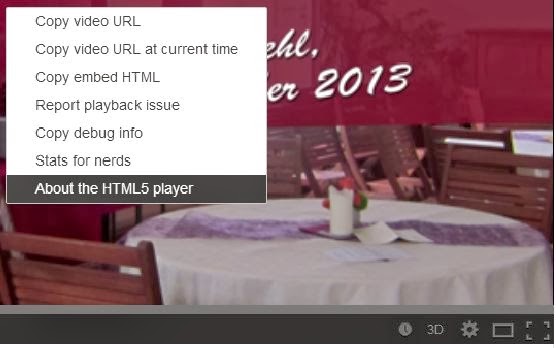
You maybe need to load a HTML5 player 
Right click when you are on a video and you get the choices, take the HTML5 line
(YouTube layout will look the same, as allways, after the download!)

This video seems to be working - you can test on it
http://www.youtube.com/watch?v=FqJd-l5si1Q


GREAT NEWS!!
(original posting August 2013)
YouTube has activated a speed control function for Chrome  and for Firefox!
and I maybe need to add at my area


        You get acces to the menu by clicking on the 5th icon from right - yes, the round one.

One of my computers had difficulties to return to normal speed but when I clicked another quality level it was released and I could wiew the dance in normal speed.

I notised for some months ago that YouTube was experimenting with this menu but it did not work for me and the browser I was on that moment. Great that they managed to compleet the job now!

ADDITIONAL  NEWS!!     
A friend informed me about an opt-in trial of HTML5 video on YouTube with possibility to watch the videos in a new player instead of the Flash player

http://www.youtube.com/html5   and choose to use the html5-videoplayer.

                              
2013 -08-14           
It is off again - maybe too much difficulties still . . . .


I am curious to know how this project is proceeding - YouTube maybe is releasing it for different regions separately!
Could you please put a note about how it is for you!
Would be appreciated!

Saturday, April 13, 2013

Double standards or what it could be?

I am quite puzzled about the two standards applied on musicians and dancers on a tango pista in some circles.

Many of the old orchestra members had classical, long education and professional career behind them when they entered the tango scene. My musically educated friends are coming every now and then, telling about the wonders they have found in the music: Those men were so genius! they knew the rules! they were so creative!

They were not fiddlers who learned just by playing!

Yes, those musicians are at real equal level only with the professional dancers, performers, but still - Why should the preferred state for the amateur tango dancers of today be an uneducated mind, untrained body, who learned by dancing in a milonga?

I do not know the education level for these old milongueros, but many of the newcomers in tango have a lot of education and academic degrees.  I think their background does have impact on their relationship to tango and for them it includes more formal learning and education activities. That's the way we relate to new things, we want to study them!

The world has become more complicated too! If you wanted to take a walk at 60's or 70's or earlier you just went out and took a walk. Today it is much more elaborate process. You need to think of your shoes, clothing, technique and devices. When I made a search for Nordic walk, ONE of the walking techniques, I got 48.000 hit on youtube and I think thousands of them are relevant. Why would tango activities stay outside of this trend?

So the main questions here are:

How can real, true music performance include education, training, performing, admiration of the audience and still be moving and true? But in the same time the dancer is losing the authenticity, by training or seeking the applause and appreciation from the audience or peers?

Or have the times changed so even an amateur dancer have right to train her/his body and mind and still be a true dancer?


Sunday, March 31, 2013

Social tango

I am getting more and more uncomfortable with the mixed use of words *Social Tango* describing a way of dancing AND a social attitude.

On web and in real life discussions, the social tango refers to close/quite close embrece, certain kind of steps, caminatas central position and so on. It includes the idea that this kind of dancing is the only one caring about the others. This way of dancing is called for social tango including the idea that tango nuevo (put in here any large steps and/or open embrace.. ) never could be social tango, where dancers are enjoying the music and caring about the other dancers.

In future I try to separate these things and as a starting point it could be something like this

professional dancer - amateur dancer
Most of the time social dancer term could be used about all kinds of amateur tango dancers.

social tango - performance
All tango dancing on your day off together with your old or new friends! and of course when you are dancing on a pista is the social one.

There is several sets of rules making the dancing enjoyable for us all, but more thinking is needed about it; do I want to put the rules together with the idea of the social tango?  Isn't social tango more defined by place, number of participants, degree of profession for the moment or similar facts?

Post script
In everyday language the *Social Tango* is understood to involve some of salogn - villa urquisa - milonguero way of movements, but I would like to have a more wide range of members in tangofamily.

Saturday, March 2, 2013

Gangnam style


Are you one of the millions of Gangnam Style fans?  and maybe you even know that Gangnam is a city district in Seoul, South Korea. But you maybe didn't yet know that Gangnam has a connection to tango too, Yes it has, because Gangnam-gu is the place for Seoul Tango festival in May.

I should have gone much earlier! but May 2012 was my first visit to South Korea. It is a lovely period for traveling on this peninsula. Wether is warm but not hot or humid and during my tree weeks in the country I had only one rainy day!
But now to dance  ==>>

Gangnam Dance Hall
My first milonga was the one on Friday night - 4th of May. The venue is a dance hall even on the other nights and mostly for other dances. Many of the routines were the same in Seoul as at home!  You could se the couples and singles with shoe bags walking to same direction as you, at the wellcoming table you name and ticket were checked and your signature was requested here as well as other places in the world. The only and wonderful difference was that the delicious buffet included in the milonga price. People were sitting at round tables and eating a bite every now and then.

This night I talked with the visitors from Japan, China, Honkong, Singapore, Malaysia, Australia, a few from Europe, Russian and some of them were here for tenth time.

The most fascinating thing was that my capeceo was understood even if it was the first time for these followers to dance with a femail leader.

Please enjoy  a waltz together with me .....

Click here!


Click here!


SC Convention Gangnam
The Saturday milonga was at a larger venue and I had some difficulties to find there. A friendly young man in a sports car gave me a ride to the place after finding the instructions on his GPS navigator.

There was food again ! highly apprciated after wandering around in the night

Maybe a milonga this time ... ?

Click here!
 

Click here!


Here you find my earlier posting and portal about the Argentine and Asian performers!
http://leadingladyl.blogspot.se/2012/06/seoul-tango-festival-2012.html


Some more information about Gangnam - Gu
http://global.gangnam.go.kr/globalIndex.do?lang=en

Tuesday, January 22, 2013

Beginner vs. World champion match

I know very few followers who have continuously, daily training as the strategy to become better dancer. Most followers take courses every now and then and consider the dances with more advanced leaders as their main strategy.

Think of a tennis court where a world champion is playing with a beginner. Yes, his skill makes it possible to return all the balls and if he is a nice person, he can drop some of them to create a friendly atmosphere. His skill makes it also possible to place the balls so they are easy for the beginner to return.

The situation is totally different for these two. The beginner is amazed that she is able to play with the world champion and she thinks she is really good, playing with all her capacity. For the champion this is not so much about skill training, playing at the edge of his ability, but about caring, to be nice.
The biggest issue here for me is the situation when she returns to the same tennis court, but this time with another beginner. The match is totally different and it is easy to explain the difference by pointing this new playmate to 10 levels lower stage ( incorrectly). This kind of false idea of your own level creates difficulties in learning and you maybe get to the partnering stage later.

Partnering stage is (for me) when both are playing/dancing at the edge of their skill without compensation from the other, mutually exploring new things.

*This posting is a responce to a specific situation for followers but some parts could be valid for leaders too.

Saturday, December 8, 2012

Ricardo Vidort and Muma

Ricardo Vidort
Every stage of your path in tango has its own scenery. This is for a milonguero who has danced for 60 years. At this point it is quite sure you got the essence of this dance clear for you.

The most important for me is this:*The body doesn’t think, the body feels the music as a way to move it and walk, and if we put attention to what our body is feeling, we shall see we are moving.*

Old milonguero knowledge for you via an interview with Ricardo Vidort on Jantango's blog
http://jantango.wordpress.com/2012/08/31/ricardo-vidort-again-in-his-own-words/

An video interview with Muma, who has been dancing with Ricardo Vidort.
http://www.youtube.com/watch?v=1QfDZVX9wpI&list=UUKAaJeHDmrdn0J4XHrXiLwg&index=1&feature=plcp

Muma as teacher
We are different as persons and need different methods to easily learn to make moves connected to the music. It seems that Muma has a different way giving a key to some learners. Please read this story:

*In my experience, sequences held me back for years learning AT, I think because my mind didn't have the framework for them. Sequences are definitely not a necessary part of the learning experience and the first teacher able to teach me social dance, was Muma, a Molinguera who just had me walk and feel the music and then after I mastered that, she then taught me several little things like ocho cortadas (just the cortada piece which can be on the right or left), weight changes, double times, check steps, trespies, ocho steps, various turns, back steps, crosses and back crosses which can all be done in an amazing variety of ways.

I actually think that most people like me, unable to learn from sequences, end up dropping out and quiting tango and the only reason why I never gave up is because I was extremely stubborn. I actually thought that I had a learning disability until I met Muma and she straightened me out ridiculously fast. I know that some people have minds with a frameworks such that sequences work well for them and I have nothing against that. I see it as intuition vs. intellectual ways of dancing and I can respect both, but intuitive dancing feels much better to me personally. It is a real shame that there are so few teachers that can teach to intuitive minds like mine. Robert Hauk is one of the only teachers within 100's of miles of me that I can actually learn from, and kinesthetic learners like me mostly leave tango and never come back. I have talked to a lot of other people (artist types) who were unable to learn tango from sequences and I think sequences are much better teaching aids for analytical people like programmers, engineers, or mechanics, which is why there are not many artist types dancing tango.*  (link to the original posting)

A lesson with Muma
http://www.youtube.com/watch?v=p32q5E1lYVQ&feature=relatedhttp://www.youtube.com/watch?v=p32q5E1lYVQ&feature=related


Saturday, November 24, 2012

A feeling of speed

After thinking a lot i noticed that the speed in music has two aspects as i see it. I try to explain how i am reasoning.

We keep us to the four quarter notes, 4/4 time signature

The first option is how long every and each quarter note is sounding. If we think ordinary tango with 5 parts, 16 measures each, then we get totally 80 measures which usually takes 2,5 mins to play. But we could modify the music file and play it faster, in 2 mins or slower so it takes 3 mins.

How many measures are passing per minute?

Another way to create a feeling of speed is the number or accents within a measure demanding our steps.

How many accents there is per measure?

As dancers we can decide the number of accents we want to use for our steps. Usually in tango we have two accents per measure. If we would step only on 1 and the same for next measure we create a much calmer, slower feeling. In milonga there is 4 accents and when we take them all it can go quite fast!

How many accents we step per measure?

When you are playing a dance video in slow motion you are using the first alternative. The music and dansers steps are the same but sloooooower.


                    In dance the steps are the changing element and the music a constant

Sunday, November 18, 2012

Traspie thoughts!

I am pretty convinced that traspie is used as a group name for all steps faster than double-time steps in tango. These fast steps come up every now an then in tango but regularly in milonga. Follow me!

When we are talking about ordinary tango, 4/4, there is a shared understanding for the usual steps, where they should be placed and how they relate to the music and the notes! The following variations are known even if there is a lot of frustration because of the names of them. In the illustrations below you find all the four beats, accents, for a 4/4 tango written as B1, B2, B3 and B4. The accents we use for ours steps will be marked with red color.

Half time-step

We take only one step during a whole measure.

You can take a step extremly slowly or decorate during the *waiting time*.


Simple time-step

We step on B1 and B3.
 The usual way to walk, to go in caminata.


Double time-step

You can do it like B1_B2_B3  or  B1_B3_B4 as illustrated below!

These are the fastest basic steps in tango in two variations.

These are the names for basic speeds for tango steps but there is a lot of situations when it goes faster and those steps are called traspie. There is traspies in tango, but it happens far more often in milonga. The ordinary milonga steps are double as fast as for tango. When you in tango take two steps you are putting down your feet four times in milonga.(*) So basic milonga steps are as double-time steps in tango, continuously. It means that if you do some kind of double-time steps in milonga they end up in traspie group; they are double-double-time in tango.

To review the traspie possibilities in milonga we need to understand the structure of milonga first. It has a basic rhythm with two accents, two beats marked below as B1 and B2, and the measure is 2/4. Above this basic rythm we have a fixed rhythmic pattern often called habanera and here marked by H1, H2, H3 and H4. Pay attention for the differences in duration for habanera accents. The basic rhythm and habanera are sounding together at B1/H1 and B2/H3 but H2 and H4 are sounding alone. Please check here! The red ones are for your steps!


The explanation below is valid for all milongas but it is not so easy to hear or produce them during a fast milonga. So try them while listening to a slow milonga, for example Milonga Sentimental.

Traspie variation 1
We step on both beats in this milonga measure, B1 and B2, as well as H4. This could be seen as a double-time step in milonga - but keep in mind that it is double-doble-time compared to tango steps above.


You can dance this in many different ways but to start with use rock step. B1 right foot forward, B2 left foot forward, H4 rockstep backward, B1 forward

Traspie variation 2
Here also we step on both beats, B1 and B2, as well as on c. There is no clear accent for c and if you have a trained ear you can get a feeling to step offbeat.This could also be seen as a double-time step in milonga/double-double-time step in tango as the case was for Traspie variation 1 above.

 
You can dance this in many different ways but to start with use rock step. B2-right foot forward, B1 left foot forward, c rockstep backward, B2 forward


Traspie variation 3
This traspie is fundamentally different compared to the ones above because it introduces a double-double-doubel-time step compared to tangons double-time step. We use the both basic beats B1 and B2 but this time we step even on the second habanera accent H2.


We can use the rockstep here too but the time space is so short that there is hardly time to rock but only replace the foot before us some centimeter further forward. This gives me a clear feeling of stumbling.

Here you have a link to Milonga Sentimental as a guitar version with sheet music.
http://www.todotango.com/spanish/las_obras/partitura.aspx?id=253

(*)

Milonga   
Measure I                                                                                    Measure II


Tango
Measure


.

Saturday, September 29, 2012

Expressions of follower musicality

I have had hard time trying to find the difference between a musical expression and an adorno. Both are part of the follower's musicality and so far the degree of independence of the movement is the most clear difference I have found. For adornos a follower takes own initiatives based on music and the time available. One of the most frequent adornos are the small kicks done every now and then. Another possibility is the marking with the toes on music.

Noelia is following fantastically the piano here!


The followers can find a lot of ways, when carrying out the lead and they have a lot of space to find a personal way to take the steps according to her personal musical taste.

Here you have one of Juana's! That planeo is fantastic!


But there is a beautiful area in between these two, where the follower just adds something extra to the lead.

Watch this, when Juana takes the step and goes down following the piano.


Or this one from Noelia when she divides the step to a series of steps; first slowly and then with two markings!

Friday, August 24, 2012

I am touched

When I started to dance, there were no YouTube videos and I didn't have access to videotapes either. The skill and knowledge in our community was the whole universe and the local teachers were the only source of knowledge, our heroes and heroines. We were enjoying our dance!

Things have changed since then and today the best performances are always availble in the net, so my eyes are used to certain standard.  And that little voice inside me is always looking for mistakes, criticising. That little voice is keeping me on the surface, keeping me from experiencing anything.

There has been two situations where this critical voice has been shut up, repeatedly! In both cases the couple was dancing and in their dance the music was more in center than the steps. Suddenly I noticed that it was quiet inside me and I was deeply enjoying the dance.

The third one is this video where an old man is singing in an afternoon milonga. I discovered this clip about a year ago and since then I have returned back every now and then. When I am listening to his song, I get alive inside, somehow his song is giving me an anchor to the deeps inside me. I am touched.


Live Music with Kate & Roberto


Saturday, August 18, 2012

My odd musicality

I have no musical education so the basic singing and some dancing are the only active experiences of music before tango.

For some reason I started to walk to music and I soon noticed that at certain times the steps got a deep meaning for me. Then suddenly I felt again how ridiculous it was to walk around to music, alone at home. I started to chase these meaningful steps because those steps must connect to the music in right way. I became an intuitive dancer and I mostly placed my steps according to the structures other then basic count.

I had also lost my childhood musical memory so I never knew what was coming next - I felt as if being an audio head in an old tape recorder. This forced me to dance without any plans, but just concentrating on the music sounding NOW. You don't necessarily need to know what is coming next; Followers are actually doing that all the time - they seldom know what movements are coming next. Leader's relation to music is similar as the followers relation to my steps.

For these reasons I was TOTALLY unaware of beat, phrases and the parts of tango.

How was I doing then?
In the beginning of a song I let my body move on the spot and find the music, find the feeling of meaningful movements and then go. Some times I was pointed out as the only (!?) one on the small pista who was stepping on the beat all the time. I got positive feedback on my phrasing and my dancing was great fun for followers too.

But to participate on a musicality workshop was a living hell to me!
Walk on beat .......? Walk only on 1 ....?? I was painfully aware of being different, I was out. I tried to look how others were doing and asked my follower. The last two years of that period I was aware of that others heard something very vital in music, but what? I couldn't form a question and nobody asked me how I was doing.

About two years ago a tango friend gave me Joaquin Amenabars book Tango:Let's Dance to the Music! I started to do the practical exercises and two weeks later I heard first time the beat - I was totally exhilarated! Totally! Several years of frustration was canalised in work with that book. I have done it several times alone and several times with tango friends.

But there is one big devil!
My early tango was magical, something between my body and the music. I did not have control of it, the first time in my life my aware brain did not have anything to say when the feet were dancing. Quite interesting, nice!

I was and I still am afraid of that the musical training changes my dance to some kind of mechanical step machinery. Therefore I try to balance the technical drills with other exercises to keep the magical, emotional side strong enough

Sunday, August 5, 2012

something about the Stages of tango

I started to dance tango 1998, which makes me ancient compared to many in our community. When I have looked  back over these years I have had a blurred feeling of passing through different stages since I started. But for some reason this feeling has never manifest itself in writing until two weeks ago when I in the middle of a facebook discussion put it in this way:
"I put it a little bit simple here, but at the beginning and intermediate level I needed a follower. If she didn't understand my lead and did something else => there we were standing, loading for a fresh start.
Today I need a partner - a mentally strong follower with her own musicality. If she misinterprets my lead, we just go on dancing, it doesn't have impact on our flow. If I don't *feel* her presence in our dance I feel lonely. 
This subject seems to be in the air today because a few days later I found a picture describing the 5 stages of tango. It is well done with thoughts quite correct and visually beautifully formed. It is a very good aid to stimulate your own thoughts about what you have passed by and the joys you’ll have in future. 

I'm sorry that the picture is not readable, please follow this link! (Ctrl + and it gets larger)


Credit to Steve Morrall, Tango UK (the author)
http://www.tango.uk.com

If we were able to form some kind of shared understanding of development stages for tango it would be easier to discuss. Today many of our discussions are confusing because we mix the details from different levels during one occasion. In my opinion the feeling, experience, thinking and performance of tango phenomenons are different at different levels.
I hope we will some day in future have a kind of shared understanding!

A personal variation at an undefined stage


An unexpected change has occurred in my dancing habits. Through all my dance years I have been very independent, heading to the practicas and milongas without knowing who will be attending. There was always people to fill the hours with wonderful dance.

 But not anymore! Today I am painfully depending on my most nearest dance partners. Last week I made an effort and went to a wonderful outdoor milonga knowing that my main partners were out of town. I was mingling around and I asked for one dance but that was it! I didn't got the urge to dance. I was chatting some more and then I left for home.
....................never happened before.

Thursday, August 2, 2012

balancing vs. loading

During the entire last year I was following about a half a dozen tandas. That's not much and I can tell you my following is rusty. I have though plans for a slight change here and therefore I did accept a few follower tandas when I was asked in Finland at Tampere festival.

I was like seaweed in storm chasing my balance! It was fascinating. I know that I have good balance as a leader and on my ballet lesson I can stand on my toes in pose and keep my balance for a moment. So it can’t be a balance problem, but WHAT is it then?

The only reasonable suggestion I came up to was: Did I load my steps with incorrect amount of energy?

Think of this situation: You are running and then suddenly you must stop. And there you are waving your arms, moving your whole body and trying to absorb the surplus energy. I am sure you know the situation!

I think now that my balance problem actually was an inablility to give my step the right amount of energy as well as my inability to effectively take care of the surplus of energy.

I think that the experienced followers are really good at allocating the right amount of energy for every single step and it gives them soft and effortless flow of steps. If they misunderstand the lead they can effectively absorb the surplus energy or add some more if needed!

Those abilities I had lost during the years I was following so few tandas.

Addition 15.08.2012
Many followers are talking of balance problems. I think we could help me/them by finding some exercises how to more exactly read the lead and how to alternate the strength used for the steps.

Monday, July 30, 2012

Follow with me to a milonga in Finland!

So often we just follow what the great international stars in tango are doing, all the big performances and events around the world. For some time I have felt a joyful need to find ways for tango dancers to breath the milonga air at far away places. So....

Please take your time and participate at a Finnish milonga with me!

This Friday evening milonga is part of a Finnish summer camp for Argentine tango. The festival is at Tampere which is surrounded by two big lakes and of course we will come together on one of the islands. We were extremly lucky with warm and sunny weather so even on the ferry a thin jacket was enough! Quite unusual this summer. Pay attention on the very last part of the video so you can spot the floating sauna with visitors!
 
But now hopp on the boat and enjoy the trip to this nights venue!

(for full screen - click the right, down corner!)


There is windows in all directions and water is visible behind the trees. Notice that this video is taken at 10.30 PM and the sun went down about ten minutes earlier.This evening the performers are from Finland or have a strong connection :)  to Finland! 
The first couple is Pasi & Maria Lauren. 
         Please enjoy!

Maybe a vals with them? Push here


The next couple is Arttu Artkoski & Carina Quiroga! 
          Please enjoy!

How about a one more tango? Push here please

I had travelled all day and was quite tired so the best choice was to take the first boat back to town. Now at 11.30 PM it is nearly dark, but not so long, at 4.40 the sun will go up again! Tammekoski-boat comes to fetch us and some of us continue dancing on the deck to a song from a Nokia phone! (must be so because Nokia county is just a few kilometers from here!)

 If you would like to follow what is happening in the Finnish tango Universum you may try these links


Argentine tango
https://www.facebook.com/groups/5555248820/
http://www.amigosdeltango.fi/event/2012/07/27


Finnish tango
Be aware that this festival has totally non-Argentine character and structure!
http://www.tangomarkkinat.fi/en/program.html
.